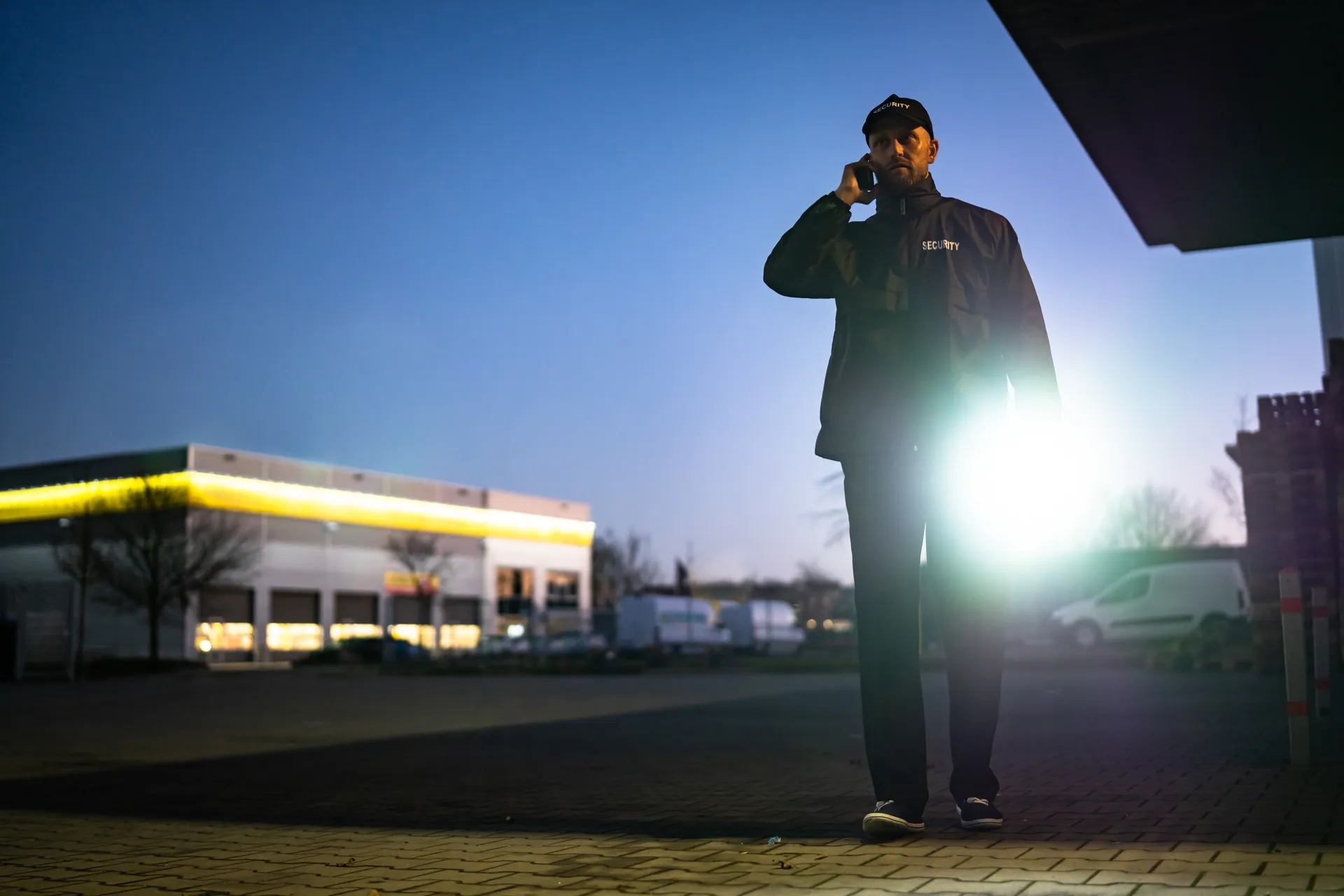
One of the first questions property managers and business owners ask when hiring a security company is whether they need armed or unarmed guards. It sounds like a simple question, but the answer depends on several factors that are specific to your property, your industry, and the nature of the risks you are trying to address.
This guide breaks down the real differences between armed and unarmed security guards, the situations that call for each, and the questions to ask before making the decision.
What Is an Unarmed Security Guard?
An unarmed security guard is a trained security professional who does not carry a firearm. They rely on observation, communication, de-escalation, and reporting to manage security across their assigned area.
Despite not carrying a weapon, unarmed officers are not passive. They are trained in conflict resolution, emergency response, access control, and incident documentation. Many carry non-lethal tools such as two-way radios, flashlights, body cameras, and in some cases batons or pepper spray depending on the assignment and local regulations.
Unarmed security officers are the most commonly deployed type of guard across commercial properties, and for good reason. The majority of security needs in everyday business environments, managing building access, deterring opportunistic incidents, monitoring common areas, and documenting activity, do not require a lethal force option. Presence, professionalism, and attentiveness handle most situations effectively.
What Is an Armed Security Guard?
An armed security guard carries a licensed firearm as part of their duties. In California, armed guards must meet significantly stricter licensing requirements than unarmed guards, including firearm qualification, additional training hours, and a valid Exposed Firearm Permit issued by BSIS. As of January 2026, armed guards who carry shotguns or rifles must also obtain an enhanced armed guard registration.
The presence of a firearm changes the dynamic of a security deployment in meaningful ways. It raises the deterrent level for threats involving violence or weapons, and it gives the officer the capability to respond with force in situations where that is the only appropriate option. But it also introduces liability, increases insurance costs for the security provider, and requires a higher standard of judgment and training from the officer deployed.
Armed guards are not simply unarmed guards with a weapon added. They are a different type of deployment with a different risk profile and a different set of appropriate use cases.
The Key Differences Side by Side
Training requirements. Unarmed guards in California must complete a minimum of 8 hours of pre-assignment training and 32 hours of on-the-job training within the first 6 months. Armed guards must meet those same requirements plus complete firearm training and qualify for their Exposed Firearm Permit.
Cost. Armed guards are more expensive to deploy. Higher training requirements, licensing costs, and insurance liability all feed into the hourly rate. For most standard commercial deployments, the cost difference is not justified by the actual risk level of the property.
Liability. Any use of force by a security officer creates liability exposure. Armed deployments amplify this significantly. Any situation involving a firearm, regardless of outcome, will involve legal scrutiny. This is not a reason to avoid armed guards when they are genuinely needed, but it is a reason to be deliberate about when they are deployed.
Environmental impact. A uniformed armed guard at the entrance to a children's hospital, a school, or a boutique hotel sends a very different message than an unarmed officer in the same position. The perceived environment matters for how tenants, customers, patients, and visitors experience the space.
Response capability. In a situation involving an armed threat, an unarmed guard's options are limited to communication, evacuation, and notifying law enforcement. An armed guard has an additional response option. This distinction matters in high-risk environments and is largely irrelevant in most standard commercial deployments.
When Unarmed Security Is the Right Choice
The majority of commercial, residential, and institutional security needs are met effectively by unarmed officers. Consider unarmed deployment when:
The primary goal is deterrence and access control. A visible, professional security presence deters opportunistic crime and manages who enters the building without requiring a firearm to do so. Lobbies, reception areas, retail floors, parking structures, and residential common areas are all well-served by unarmed coverage.
Your environment is customer or patient-facing. Healthcare facilities, hospitality venues, and educational campuses benefit from security officers who project calm authority rather than force. In these environments, de-escalation and communication skills matter far more than a weapon.
The risk profile is low to moderate. If the primary threats you face are trespassing, vandalism, package theft, unauthorized access, or general disturbances, unarmed coverage handles those situations effectively.
You are managing a large event. For most events, unarmed security manages crowd flow, checks credentials, and handles access points without introducing the complications that armed personnel create in dense public gatherings.
When Armed Security Is the Right Choice
Armed security is appropriate when the risk level genuinely justifies the additional cost, liability, and environmental impact. Consider armed deployment when:
High-value assets are present. Properties that store large amounts of cash, jewelry, pharmaceuticals, or other high-value inventory attract a different category of threat. Organized theft operations will not be deterred by an unarmed presence alone.
The location or industry carries elevated risk. Financial institutions, armored transport operations, cannabis dispensaries, and certain government facilities operate in environments where the potential for armed confrontation is meaningfully higher than a standard commercial property.
There is a documented or credible threat. If a specific individual has made threats against employees or the property, or if there is a pattern of violent incidents in the immediate area, the threat level may justify armed coverage for a defined period.
Executive or VIP protection is required. High-profile individuals in certain industries require protection where an armed capability is part of the deployment. This falls under executive protection rather than standard property security.
The Question Most Property Managers Skip
Before deciding between armed and unarmed, most property managers focus on threat level. But there is a more fundamental question worth asking first: what is the specific outcome you want security to achieve?
If the answer is deterrence, access management, documentation, and a professional visible presence, unarmed coverage delivers that at lower cost and with less complexity. If the answer includes the ability to physically intervene in a violent situation or protect against an armed threat, then armed coverage is worth the additional investment.
A qualified security company will help you answer this question honestly based on an assessment of your property, your industry, and your actual risk exposure rather than defaulting to one option without context. Door Guard Security Corp provides both unarmed and armed security services and can assess which deployment is appropriate for your specific environment.
Final Thoughts
Armed and unarmed security guards are not interchangeable, and the right choice is not always the more powerful-looking one. For most commercial properties, unarmed officers deliver exactly the deterrence, access control, and professional presence that the environment requires. For higher-risk deployments where the threat profile genuinely warrants it, armed coverage provides a capability that unarmed personnel cannot replicate.
The decision should be driven by an honest assessment of your risks, your environment, and what you actually need security to accomplish, not by assumptions about which option sounds more serious.